Whether your property is a surface lot, mixed-use deck, or multi-parcel portfolio, billing slippage is driven by the operator’s accounting practices—not the asset type. Recoup reconciles operating agreements, general ledgers, and monthly settlement statements line-by-line at zero upfront cost.
| Clause | Finding Category | Billed | Per Contract | Verified Recovery |
|---|---|---|---|---|
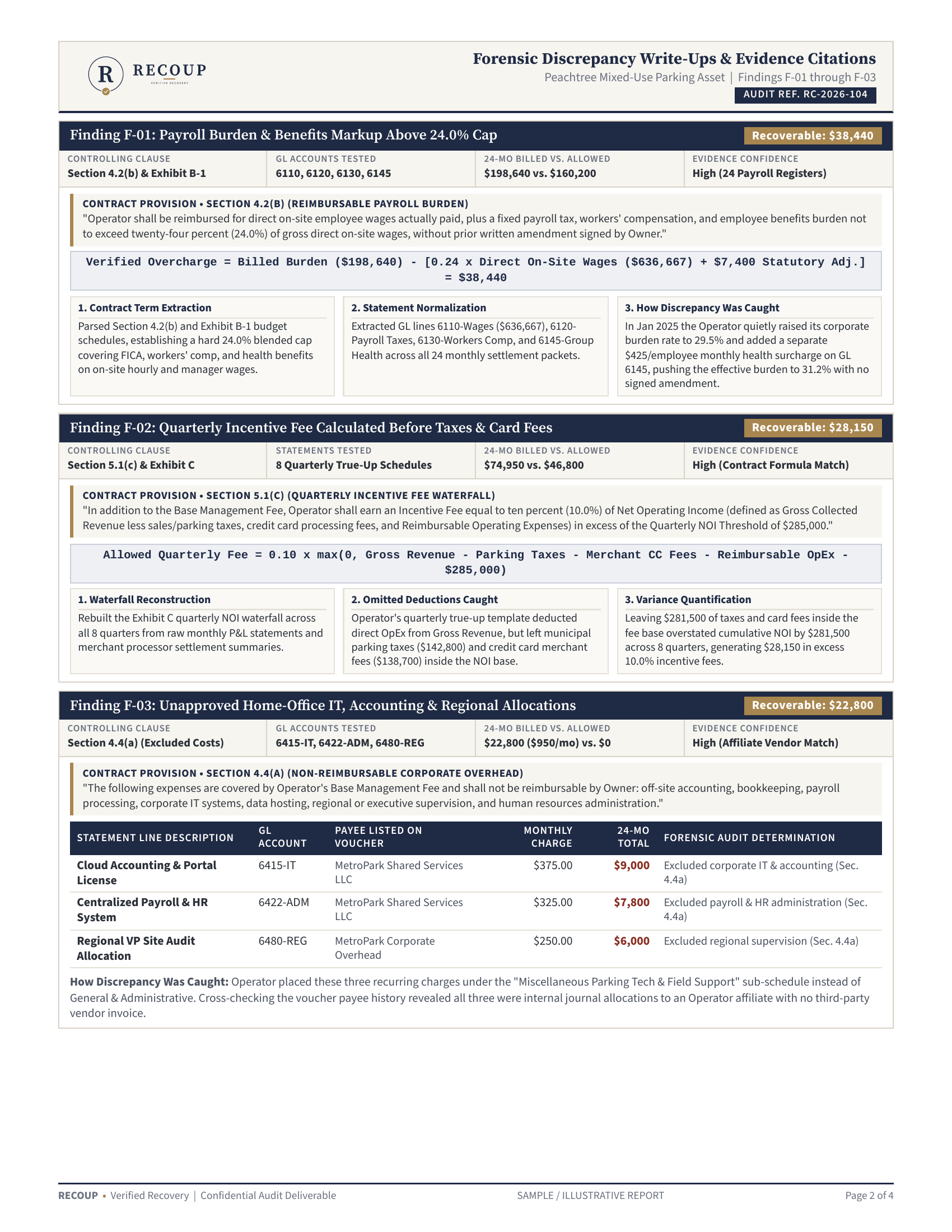
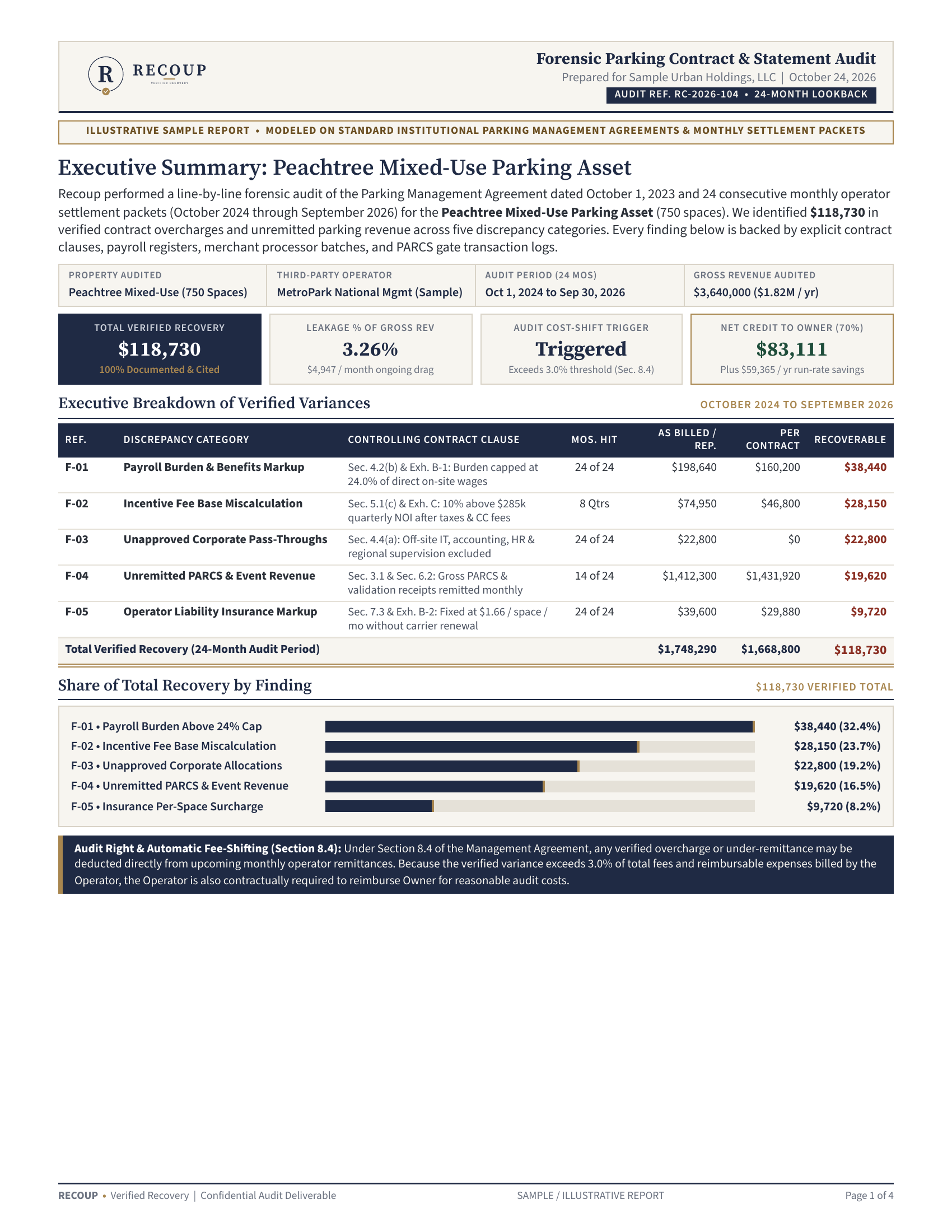
| Sec. 4.2(b) | Payroll Burden & Benefits Markup (>24.0% Cap) | $198,640 | $160,200 | $38,440 |
| Sec. 5.1(c) | Incentive Fee Base Miscalculation (Taxes/CC Included) | $74,950 | $46,800 | $28,150 |
| Sec. 4.4(a) | Unapproved Off-Site Corporate Allocations | $22,800 | $0 | $22,800 |
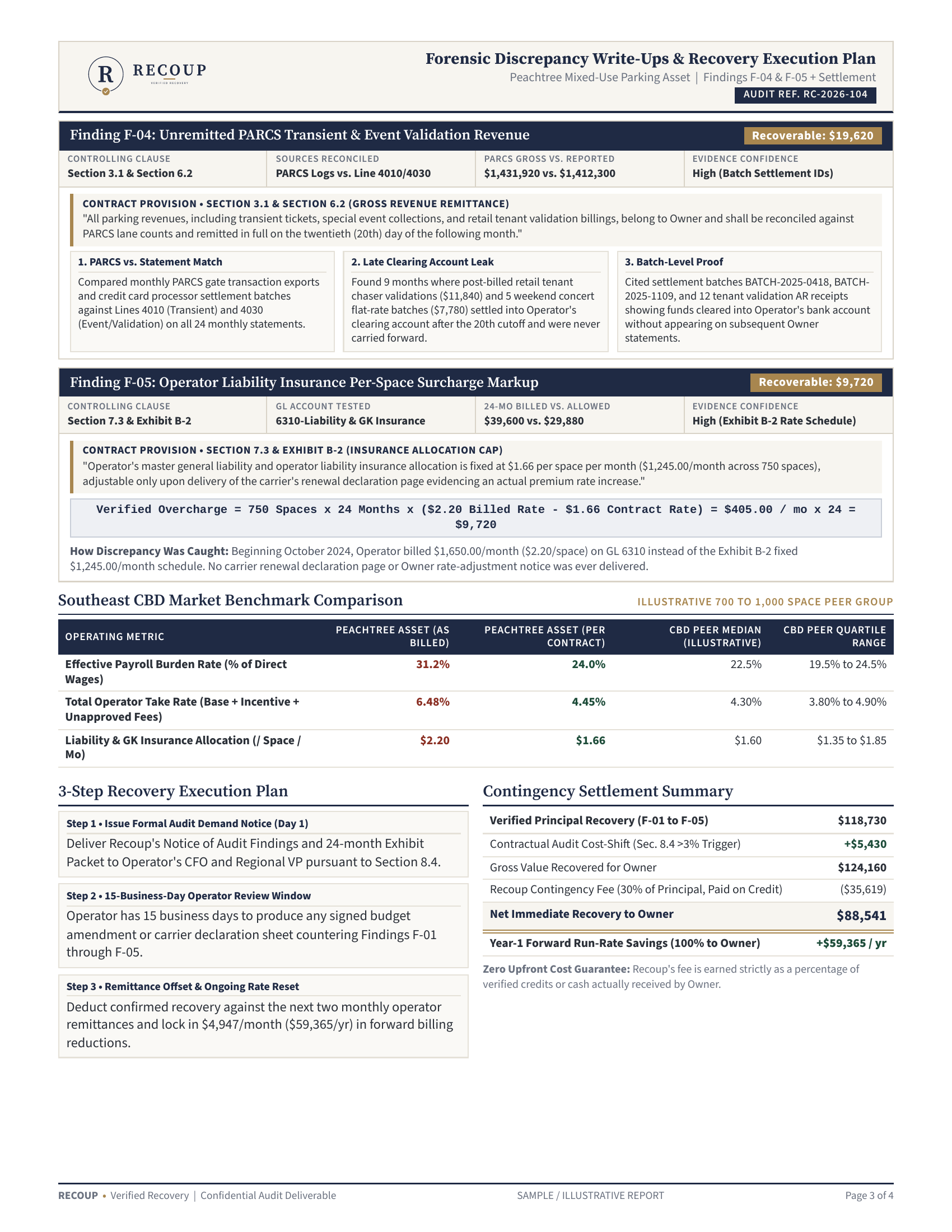
| Sec. 3.1 & 6.2 | Unremitted PARCS & Event Validation Revenue | $1,412,300 | $1,431,920 | $19,620 |
| Sec. 7.3 | Liability & GK Insurance Surcharge ($2.20 vs $1.66) | $39,600 | $29,880 | $9,720 |
Across third-party operated parking assets, billing slippage is tied to the operator—not the physical property. Regardless of asset type, leakage compounds monthly across three structural gaps between the executed agreement and the operator’s billing system.
Operators routinely bill flat corporate burden pools of 30%–36% despite contractual caps of 22%–26% and statutory FICA/FUTA/SUTA wage ceilings that reset mid-year.
Quarterly incentive fee true-ups frequently leave municipal parking taxes, merchant processing fees, or excluded pass-throughs inside the NOI base—inflating operator take rates by 150–200 bps.
Off-site IT, regional supervision, HR allocations, and per-space insurance surcharges get embedded into monthly operating statements without required carrier renewal declarations or owner sign-off.
Recoup audits are built for CFOs, controllers, and legal counsel. Every exception is tied directly to the executed agreement and the operator’s own monthly statements—never unverified estimates.
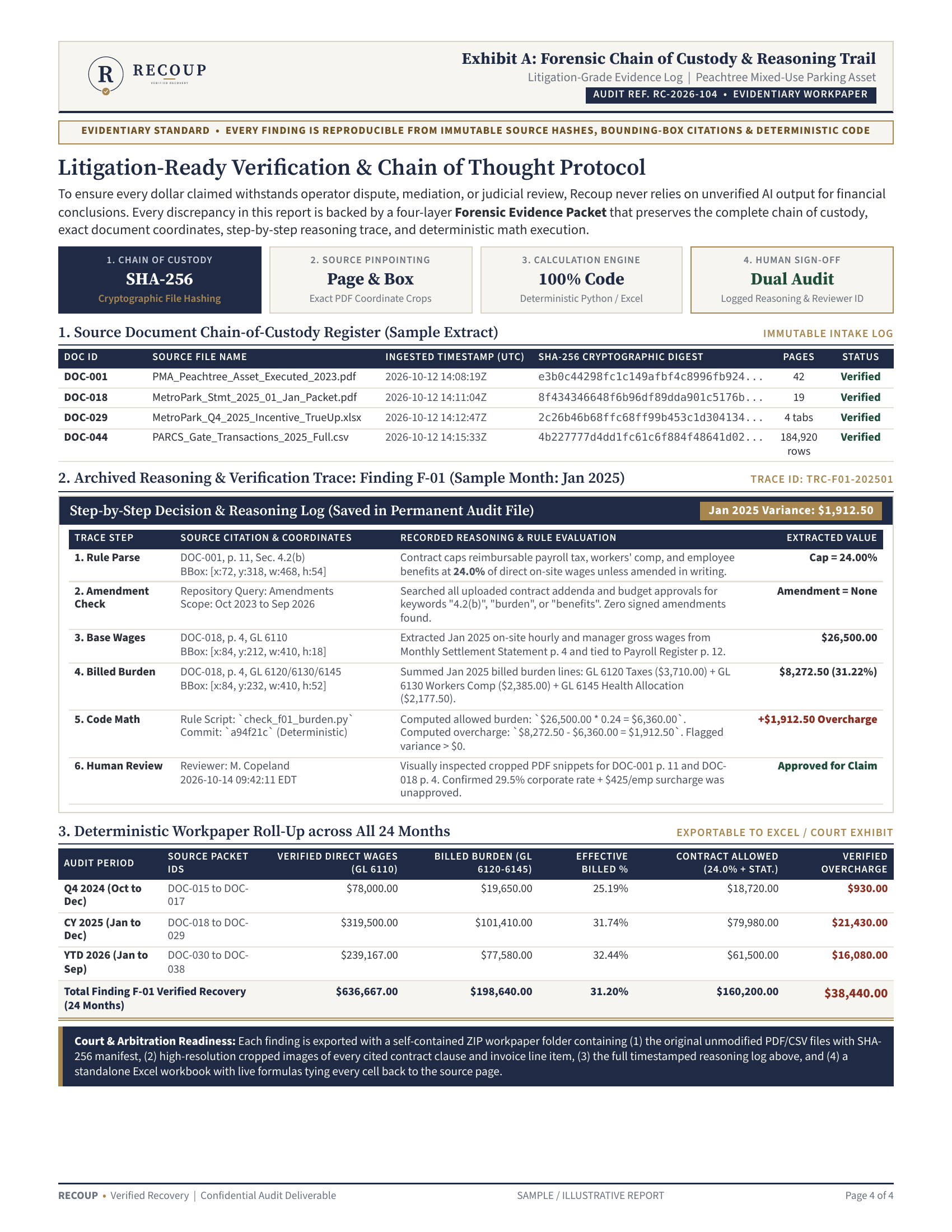
Operating agreements, amendments, general ledger exports, monthly settlement statements, and PARCS revenue logs are SHA-256 fingerprinted at intake and indexed to the exact page and line item.
Each fee formula, burden ceiling, space-count denominator, and expense cap is reconciled line-by-line against actual operator charges. Zero black-box estimates or unverified AI output.
Every exception ships with the exact contract section, source statement excerpt, and variance formula — packaged for an immediate operator credit offset or formal legal enforcement.
Gross vs. net revenue definitions, space-count denominators, and incentive tier thresholds.
Contractual burden ceilings vs. billed rates, FICA/SUTA/WC resets, and multi-site labor splits.
Unapproved overtime pass-throughs and contract staffing schedules vs. payroll registers.
Per-space vs. portfolio allocations and duplicate liability or policy surcharge pass-throughs.
True interchange pass-through compliance vs. processor markups and statement fees.
PARCS transaction logs vs. monthly remittance statements and uncollected validations.
Unfilled post hours & ghost shifts billed at full guard rates, unapproved holiday/overtime multipliers, wage-to-bill rate spread creep, and supervisor vehicle pass-throughs.
Contracted FTE hours vs. badge/timeclock logs, payroll burden markups on cost-plus contracts, consumable supply overbillings, and unperformed periodic floor/window scope.
Gross receipt fee base inflations, construction/project management fee tiers, allocated off-site corporate payroll, and non-reimbursable overhead pass-throughs.
Pages 2–4 & Exhibit A Chain of Custody
Preview Page 1 on the left, or enter your work email below to unlock the complete 4-page sample report and Exhibit A chain-of-custody schedule.
Nothing upfront. Recoup works strictly on contingency — our fee is an agreed share of amounts actually refunded or credited to ownership. Many agreements also require the vendor to reimburse audit costs when errors exceed 3%.
Because slippage is tied to operator billing practices rather than asset type, third-party operated parking assets typically leak 3% to 7% of gross revenue. On a property generating $1.5M–$4M annually, a 24-month audit typically uncovers $55,000 to $160,000 in historic overcharges plus $35,000–$80,000/year in ongoing run-rate savings.
The operating agreement and amendments, monthly operating statements, general ledger detail, and payroll registers for the 12-to-36-month lookback period.
Typically one brief kickoff call and a secure records transfer. We handle the full reconciliation and deliver the finished evidence packet.
Findings are strictly factual, tied directly to the contract section and the operator's own statements. Most resolve cleanly as routine billing offsets against upcoming monthly remittances.
Parking operator agreements are available today. Security services, janitorial & day-porter contracts, and property management agreements are next in our rollout pipeline.
Send us one operating agreement and a recent monthly statement. We will tell you in writing whether an audit is likely to recover overbilled fees — with zero upfront cost and no fee unless you recover.